Since it's such a rare rainy day in May here in San Diego (usually we just have the May Gray mornings without the water coming down) I thought I'd recommend a handful of good, new rainy-day noir books to read.
First of all, you should definitely be checking out the brand new
San Diego Noir collection from Akashic Books, edited by
Mysterious Galaxy's own Maryelizabeth Hart. This latest in the series of city-oriented noir fiction features stories by SoCal greats T. Jefferson Parker, Don Winslow, and Debra Ginsberg - and even better, you can meet Jeff, Don, & Debra, along with fellow contributors Gabe Barillas and Cameron Pierce Hughes on Wednesday night this week, the 18th of May at 7:30,
right here at Warwick's. While, yes, this bit reads like a plug for our event, this is the perfect rainy read, don't you think? Visions of the seedy underbelly of America's Finest City go well with heavy cloud cover and misting Southern California rains, I think. Come to the event, as it's sure to be an interesting "discussion" with these five.
Elsewhere, there's the latest novel from Philip Kerr,
Field Gray - the latest in a series of 1940's crime noir that I've been championing for years. Kerr originally wrote three novels about Bernhard Gunther in the early 1990's (now collectively known as
Berlin Noir) which chronicled the detective's life as a pre-WWII Berlin hotel detective and just after the war as a private-eye of sorts. Bernie is a throwback to the
Raymond Chandler,
Dashiell Hammett type of protagonist - a surly, smart, sharp-tongued, ladies man, he smokes & drinks his way among both the bottom dwellers and the upper crust of Berlin society as he attempts to right the wrongs of the world he lives in. This is no small task in Nazi Germany, of course, and his path has taken him into the belly of the beast in books past, leading him to exile in South America. Just as
Field Gray begins, Bernie is picked up in a boat off the coast of Cuba in 1954 by American operatives, who proceed to try and get him to fill in some intelligence gaps to avoid being tried for war crimes. Bernie's recollections fill in a lot of the gaps left open by the previous six books, bringing his story full circle back to Berlin 1933, his reluctant donning of the field gray uniform of the SS in 1941, and life in a Russian gulag after Stalingrad in 1945. Of course, Bernie doesn't like to cooperate with any government or their operatives, so he's always working his mouth toward an exit strategy. The best part is that you don't have to have read the previous books, as this stands alone as a brilliant crime noir, much like Alan Furst, if that's your thing.
Since Scandinavian crime novels seem to be the genre du jour these days, I'm hoping you've at least heard of Jo Nesbo from Norway, but I'm guessing not. (You may have seen
the Vanity Fair bit on him in April.) Personally, after having read all of Henning Mankell and enough of Stieg Larrson, I can
unequivocally state that Nesbo is a far, far better writer than they. His previous three novels to be translated for the American market -
The Redbreast, Nemesis, and
The Devil's Star - have featured Oslo detective Harry Hole (I'm told that his last name is pronounced "hoo-luh," thankfully) a hard-drinking, Doc-Maarten-wearing, chain-smoking hardass. I
loved the previous three books - involving Norway's dark secrets from WWII (
Redbreast), a less-than-reliable narrator/murder suspect in Harry (
Nemesis), and an underlying thread of violence and mistrust at the hands of one of Harry's fellow detectives which runs through all three.
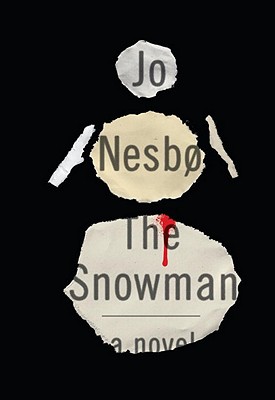
The Snowman, the latest translation to hit our shores, is actually the 7th book in the series, as Nesbo recently switched American publishers, thus skipping the 6th book, at least for the time being. While readers of the previous books may be annoyed by some finer plot points as this one gets going,
The Snowman is actually a great starting point for new readers as it remains unattached to the previous books. This centers not so much on Harry's life outside his world of detecting, at least as much as it doesn't intersect with the crimes he's investigating. There appears to be a serial killer at work in Oslo, pretty much a historical impossibility - Norway has never had a documented serial killer. Someone seems to be brutally murdering women around town, leaving a creepy signature snowman nearby each time. Harry thinks the crimes are related, of course, but he has a hard time connecting the dots as the killer stays several steps ahead of him the whole time. The relentless Norwegian press wants answers, putting tremendous pressure on Harry to find the killer, which leads to a huge political mess and even more murdering. I read a lot of crime fiction, as you can tell, and the climactic sequence in this one had even jaded ol' me on the proverbial "edge of my seat," as they say. Good, dark fun.


 Philip Kerr’s Prague Fatale continues the tale of the cynical detective Bernie Gunther who reluctantly serves as a bodyguard to the Nazi’s Reinhard Heydrich, who fears for his life. He is so good at his job that the country’s leaders overlook his anti-Nazi sympathies. (Gunther is introduced in Kerr’s trilogy Berlin Noir). Gathered in a country home are many of the Gestapo’s key leaders where Heydrich hopes Gunther can reveal the conspirators. Gunther’s new girlfriend is his only break during a difficult assignment, and she tells Gunther she spends her days with friends.



 Posts
Posts


